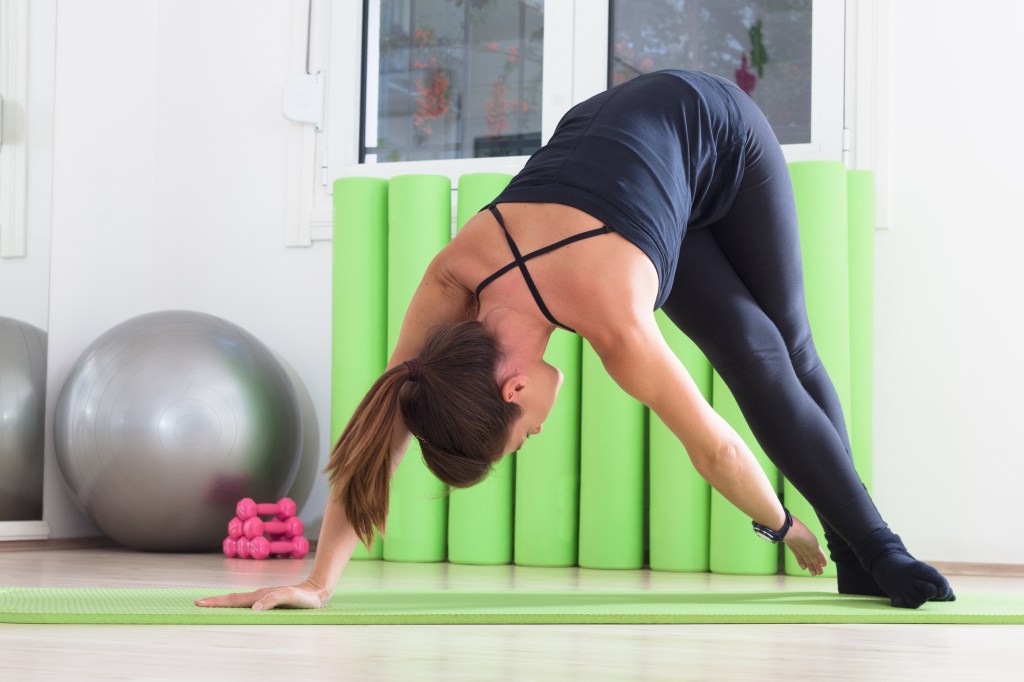
In my recent post 3 in the Decoding Posture, I talked about stability which can be a confusing subject, so I wanted to add this brief extra supplement to explain in a little more depth.
When people hear the word stability, they often imagine “holding still.” But in Pilates, stability is so much more than staying in one place.
There are two types we train:
Static Stability
This is your ability to maintain control when the body is not moving.
Think of:
- The Hundred and other supine core exercises
- Holding a plank
- Balancing on one leg
- Maintaining neutral pelvis in a bridge set‑up
Static stability builds deep support, awareness, and postural endurance. It teaches the body how to organise itself efficiently before movement begins.
Dynamic Stability
This is your ability to stay controlled while the body is moving.
Think of:
- Leg circles with the advanced pelvic rotation
- Walking with smooth pelvic rotation
- Rolling like a ball with fluid control or Corkscrew
- Side Bend or Twister
- Reaching, twisting, lifting, bending
Dynamic stability is what keeps us safe in real life — when we’re carrying shopping, climbing stairs, playing sports, or reacting to uneven ground.
Why Pilates Is So Effective
Pilates trains both forms of stability by integrating:
- Breath
- Deep core activation
- Controlled mobility
- Alignment awareness
- Smooth transitions
You learn not just to hold stability, but to move through it — which is where true functional strength lives.
A Helpful Way to Think About It
Static stability = setting the foundation
Dynamic stability = moving from that foundation
Both are essential for posture, balance, and confident movement at any age.
If you’d like to refine your eye for pelvic patterns, the Postural Assessment Course breaks this down with simple frameworks, real‑world examples, and practical assessment tools you can use immediately.
 BODY SOUL WELL