Tag: hipmobility

  • Hip Mobility & Lower Body Alignment: Building Balanced, Functional Movement Patterns

    Pilates Essentials Series — Part 7
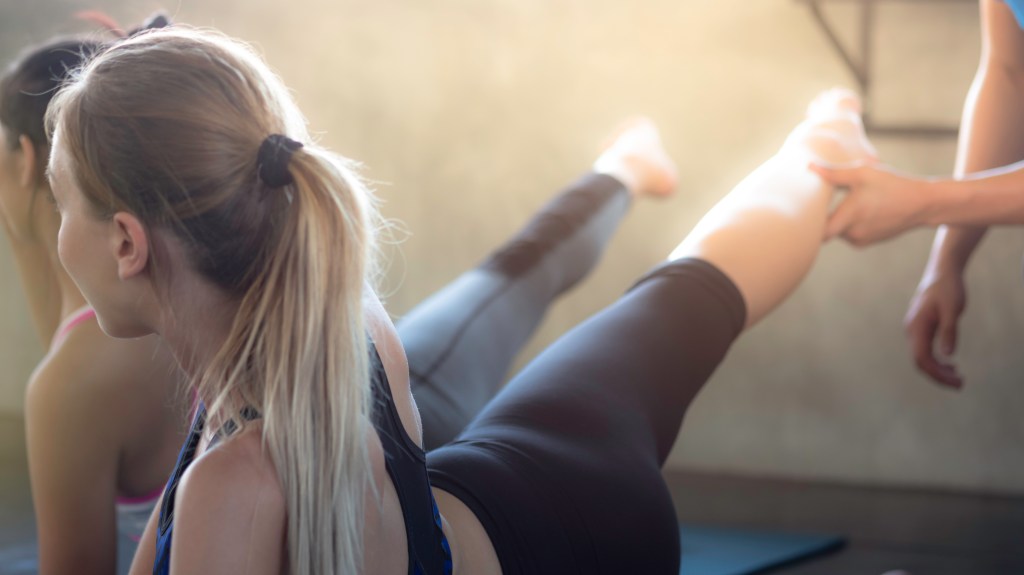
    Introduction: Why Hip Mobility Is the Missing Link in Most Pilates Practices

    If there is one area of the body that consistently shows up with tightness, weakness, compensation, or confusion in Pilates clients, it’s the hips. The hip joint is incredibly powerful and incredibly complex — and when it’s not moving well, the entire body feels the consequences.

    For Pilates teachers, understanding hip mobility and lower‑body alignment is essential for helping clients move with ease, reduce pain, and build functional strength. The hips influence gait, posture, balance, core activation, and even breath. When the hips are stiff or misaligned, clients compensate with their lower back, knees, or feet without realising it.

    In this instalment of the Pilates Essentials Series, we explore how to teach hip mobility and lower‑body alignment in a way that empowers your clients to move freely, safely, and efficiently.

    1. Why Hip Mobility Matters in Pilates

    The hip joint is a ball‑and‑socket joint designed for a wide range of motion. But modern life — sitting, driving, screens, stress — limits that movement dramatically.

    Common hip issues you’ll see in clients:

    • Tight hip flexors
    • Weak glutes
    • Limited hip extension
    • Poor external rotation
    • Overactive TFL and quads
    • Knee valgus or varus
    • Lower‑back compensation

    Why this matters in Pilates

    Hip mobility affects:

    • Pelvic alignment
    • Core activation
    • Spinal mobility
    • Balance and gait
    • Lower‑body strength
    • Load distribution

    When the hips move well, the entire body moves better.

    2. Understanding Lower‑Body Alignment: A Teacher’s Perspective

    Lower‑body alignment is not just about the hips — it’s about the entire kinetic chain.

    Key alignment checkpoints:

    • Feet: tripod grounding, arches active
    • Knees: tracking over the second toe
    • Hips: level, stable, mobile
    • Pelvis: neutral, not tipping, tilting or rotating
    • Spine: supported by the core

    The hips as the centre of lower‑body organisation

    The hips influence:

    • Knee tracking
    • Foot mechanics
    • Pelvic stability
    • Glute activation
    • Balance and proprioception

    When the hips are aligned, the rest of the lower body follows.

    3. The Three Pillars of Hip Mobility

    1. Flexibility

    Clients need adequate length in:

    • Hip flexors
    • Hamstrings
    • Adductors
    • External rotators

    2. Strength

    Mobility without strength leads to instability. Key muscles include:

    • Glute max
    • Glute med/min
    • Deep hip rotators
    • Hamstrings
    • Iliopsoas

    3. Control

    True mobility is the ability to move through range with control. Pilates excels here.

    4. How Hip Mobility Influences the Entire Body

    a. The pelvis

    Tight hip flexors pull the pelvis into anterior tilt. Weak glutes reduce pelvic stability. Both affect spinal alignment.

    b. The spine

    When the hips don’t move, the lower back compensates. This is a major cause of:

    • Lower‑back pain
    • Poor core activation
    • Limited spinal mobility

    c. The knees

    Hip weakness often shows up as:

    • Knee valgus (knees collapsing inward)
    • Knee varus (knees bowing outward)

    d. The feet

    Hip rotation influences foot pronation and supination.

    5. Teaching Hip Mobility: A Step‑by‑Step Method for Instructors

    Step 1: Build awareness

    Clients must understand how their hips move.

    Use explorations such as:

    • Leg and Hip circles
    • Leg slides
    • Standing weight shifts
    • External/internal rotation

    Step 2: Introduce alignment

    Cue:

    • “Keep your pelvis steady as your leg moves.”
    • “Imagine your thigh bone rotating inside your hip socket.”
    • “Let the movement come from the hip, not the back.”

    Step 3: Layer in breath

    Breath helps release tension and support stability.

    Cue:

    • “Inhale to create space; exhale to stabilise.”

    Step 4: Add load gradually

    Once alignment is established, challenge it with:

    • Supine core work
    • Bridging variations
    • Side‑lying work
    • Standing balance

    6. Common Hip Mobility Issues & How to Correct Them

    This is where a deep knowledge of Pilates exercises, their purpose and benefits and anatomy and physiology are essential.

    1. Tight hip flexors

    Often caused by:

    • Sitting
    • Stress
    • Weak glutes

    Corrections:

    • Stretch hip flexors
    • Strengthen glutes
    • Cue neutral pelvis

    Shoulder Bridge with the extended leg variation will address all these issues, but there are many other exercises to choose from.

    2. Weak glutes

    Often caused by:

    • Sedentary lifestyle
    • Overactive hip flexors
    • Poor movement patterns

    Corrections:

    • Bridge variations
    • Side‑lying leg work
    • Standing hip abduction

    3. Limited external rotation

    Often caused by:

    • Tight deep rotators
    • Weak glutes
    • Poor hip mechanics

    Corrections:

    4. Knee valgus

    Often caused by:

    • Weak glute med
    • Poor foot mechanics
    • Hip instability

    Corrections:

    • Cue knee tracking
    • Strengthen lateral hips
    • Improve foot grounding

    7. Cueing Strategies That Create Real Change

    Use imagery

    • “Imagine your thigh bone spiralling in the socket” or “Stirring a cup of tea”
    • “Think of your hips as headlights — keep them shining forward.”
    • “Pelvis is a bowl of water – you don’t want to spill any.”

    Use tactile cues

    With consent:

    • Hands on the pelvis (yours or theirs)
    • Guiding hip rotation

    Use functional cues

    • “Can you move your leg without your pelvis shifting?”
    • “Can you keep your knee tracking over your toes?”

    Use layered cueing

    Start broad → refine → integrate.

    8. Exercises That Teach Hip Mobility Naturally

    1. Supine leg circles

    Teach hip dissociation.

    2. Bridge variations

    Strengthen glutes and improve hip extension.

    3. Side‑lying leg series

    Build lateral hip strength.

    4. Clams and hip rotation drills

    Improve external rotation.

    5. Standing balance work

    Integrate hip stability into functional movement.

    9. Progressions for Safe, Effective Lower‑Body Training

    Start with awareness

    Clients must feel the hip joint move.

    Add stability

    Introduce neutral pelvis, core activation and knee tracking.

    Add load

    Leg lifts, bridging, standing work.

    Add complexity

    Rotation, balance, transitions.

    Add functional integration

    Gait patterns, footwork.

    10. Why Hip Mobility Elevates Your Teaching

    When you teach hip mobility well, your clients:

    • Reduce lower‑back pain
    • Improve posture
    • Strengthen their glutes
    • Move with more confidence
    • Build long‑term resilience

    And your teaching becomes:

    • More precise
    • More effective
    • More transformative

    Conclusion: Building Balanced, Functional Movement Patterns

    Hip mobility and lower‑body alignment are essential for safe, efficient, and powerful movement. When clients learn to move their hips with awareness and control, they unlock better posture, stronger glutes, and a more integrated Pilates practice.

    As teachers, our role is to guide them toward this freedom with clarity, patience, and thoughtful cueing.

    It’s not enough to just know the Pilates exercises: we need to understand the purpose, benefits, muscles involved, fascia, the role of tension stored in body. A broad knowledge of all types of movement therapy is very useful. Take a look at my Services page, scroll through and click on the links for more information.

    #pilates #somaticmovement #hipmobility
  • Pilates One Leg Circle: Unlocking Hip Health and Mobility

    Introduction: Why Hip Health Matters

    The hips are the body’s powerhouse. They connect the upper and lower body, stabilise the pelvis, and support nearly every movement we make — from walking and running to sitting and standing. Yet, modern lifestyles often leave hips tight, weak, or imbalanced. Hours of sitting, repetitive movement patterns, and lack of mobility training can contribute to stiffness, discomfort, and even chronic pain, often leading to hip replacements which run into millions worldwide each year.

    Pilates offers a solution. Among its repertoire of mat exercises, the One Leg Circle stands out as a deceptively simple yet profoundly effective movement for hip health. Often misunderstood and under-rated, this classic exercise not only strengthens and mobilizes the hip joint but also integrates core stability, balance, and neuromuscular control.

    In this blog post, we’ll explore:

    • The importance of hip mobility and stability
    • How the One Leg Circle supports hip health
    • Step‑by‑step guidance on performing the exercise
    • The deeper somatic and neuroplastic benefits
    • Practical tips for integrating it into your routine

    The Role of Hip Mobility in Whole‑Body Wellness

    Healthy hips are both mobile and stable. Mobility allows the joint to move freely through its range of motion, while stability ensures control and protection. When either is compromised, compensations occur elsewhere in the body — often in the lower back, knees, or even shoulders.

    Key Benefits of Hip Mobility:

    • Improved posture: Free hips reduce strain on the spine.
    • Enhanced athletic performance: Mobility supports efficient running, dancing, and sports.
    • Reduced injury risk: Balanced hips prevent overuse injuries in surrounding joints.
    • Better circulation and energy flow: Movement through the pelvis supports lymphatic and nervous system health.

    Pilates emphasises this balance, teaching practitioners to move with awareness and precision. The One Leg Circle embodies these principles perfectly.

    The Pilates One Leg Circle: Purpose and Principles

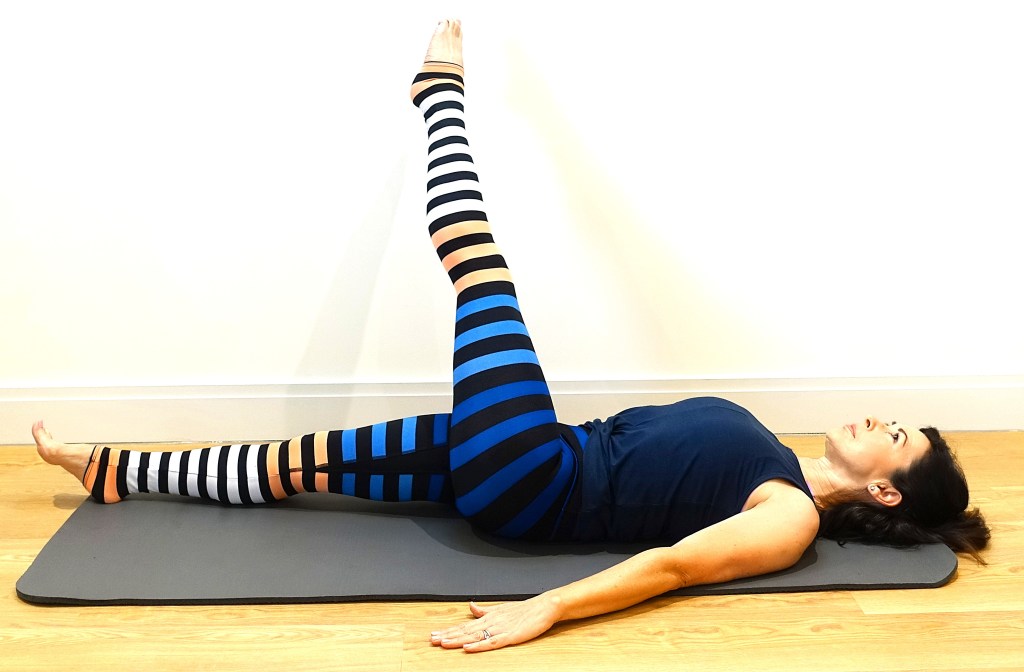
    The One Leg Circle is a foundational mat exercise (part of the classical warm up) performed lying supine, with one leg extended on the mat and the other lifted toward the ceiling. The lifted leg traces a controlled circular path, challenging the hips, abdominals, and stabilisers.

    Purpose of the Exercise:

    • Hip joint mobilisation: Encourages smooth movement in multiple planes.
    • Pelvic stability: Trains the core to anchor the pelvis while the leg moves.
    • Neuromuscular coordination: Integrates breath, awareness, and precise control.
    • Symmetry and balance: Highlights imbalances between left and right sides.
    • Thoracic Spine Mobility: the advanced version adds a spine twist

    Why It’s Effective:

    The One Leg Circle isolates hip movement while demanding stability from the rest of the body. This dual challenge — mobility plus stability — makes it a cornerstone for both rehabilitation and performance training.

    Step‑by‑Step Guide to the One Leg Circle

    1. Starting Position:
      • Lie on your back with arms by your sides.
      • Extend one leg along the mat, toes pointing forward.
      • Lift the opposite leg toward the ceiling, keeping it straight if hamstrings allow.
    2. Engage the Core:
      • Draw the abdominals back, engaging the core muscles to stabilise the pelvis.
    3. Circle the Leg:
      • Inhale to prepare.
      • Exhale as the lifted leg crosses the midline, sweeps down; as it circles back to the starting position, inhale in preparation.
      • Keep the movement smooth and controlled, tracing a small to medium circle, increasing range as stability is mastered.
    4. Repeat:
    • Perform 3 to 5 circles in each direction.
    • Switch legs and repeat.

    Technique Tips:

    • Keep the pelvis stable — avoid rocking side to side. Use your arms if necessary when you’re learning.
    • Start with smaller circles, gradually increasing range as control improves.
    • Focus on breath: inhale to prepare, exhale through the circle.
    • Imagine drawing the circle from the hip joint, not the foot.

    Benefits of the One Leg Circle for Hip Health

    1. Mobility and Range of Motion

    The circular pathway moves the hip through flexion, extension, abduction, and adduction. This multidirectional movement nourishes the joint, lubricates connective tissue, and maintains functional range.

    2. Strength and Stability

    While the moving leg mobilises, the supporting leg and core stabilise. This dual action strengthens deep stabilizers, including the transverse abdominis and pelvic floor, creating resilience against injury.

    3. Balance and Symmetry

    By isolating each leg, the exercise reveals asymmetries. Practitioners often notice one hip feels freer or stronger. Addressing these differences builds balanced strength and mobility.

    4. Neuromuscular Re‑education

    The One Leg Circle requires mindful control. This conscious movement enhances neuromuscular pathways, supporting neuroplasticity — the brain’s ability to adapt and rewire. Over time, this improves coordination and movement efficiency.

    5. Somatic Awareness

    Pilates emphasises internal awareness. As you circle the leg, you notice subtle shifts in the pelvis, breath, and tension. This somatic focus helps release unnecessary holding patterns, fostering relaxation and ease.

    Hip Health Beyond the Mat

    The benefits of the One Leg Circle extend into daily life:

    • Walking and running: Freer hips improve stride length and efficiency.
    • Sitting and standing: Strong stabilisers reduce lower back strain.
    • Sports and dance: Enhanced mobility supports dynamic movement.
    • Aging gracefully: Maintaining hip mobility reduces fall risk and supports independence.

    For postpartum recovery, back care, or athletic conditioning, this exercise adapts beautifully. It can be modified with bent knees, smaller circles, or props like a resistance band. It can also be progressed by adding the spine twist.

    Common Mistakes and How to Avoid Them

    • Pelvis rocking: Anchor the core to prevent compensations.
    • Overly large circles: Start small – bigger isn’t better if control is lost.
    • Locked knee: Keep the leg straight if hamstrings allow but not rigid.
    • Holding breath: Use breath to guide rhythm and release tension.

    Correcting these mistakes ensures the exercise delivers maximum benefit without strain.

    Integrating the One Leg Circle into Your Practice

    • Warm‑up: Use it early in a session to mobilize hips – it’s number 4 in the classical sequence.
    • Rehabilitation: Ideal for gentle re‑education after injury.
    • Progression: Pair with exercises like the Shoulder Bridge or Side Kick for comprehensive hip training.
    • Mindfulness: Treat it as a meditation in motion, focusing on sensation and control.

    Conclusion: Circling Towards Health

    The Pilates One Leg Circle is more than a leg or core exercise — it’s a gateway to hip health, mobility, and whole‑body integration. By combining mobility with stability, awareness with control, it embodies the essence of Pilates: mindful movement that transforms both body and mind.

    Whether you’re a beginner seeking freedom from stiffness, an athlete aiming for performance, or a wellness enthusiast exploring somatic practices, this exercise offers profound benefits. Add it to your routine, and let your hips move with strength, grace, and ease.

    #Pilates #hipmobility #corestability #corestrength #painrelief #hiphealth #somatichealing