Snapping Hip Syndrome (SHS) is one of those curious movement phenomena that clients often describe as “a click,” “a pop,” or “a flick” at the front, side, or back of the hip. Sometimes it’s painless; sometimes it’s sharp and uncomfortable. For Pilates teachers and movement practitioners, understanding the underlying causes is essential—not only for supporting clients safely, but also for refining our own movement practice.
In this post, we’ll explore the key contributors to SHS—muscle and tendon tightness, anatomical variations, overuse and fatigue, and intra‑articular causes—and why maintaining neutral alignment, activating the core, and reducing range of motion can make such a profound difference.
What Is Snapping Hip Syndrome?
Snapping Hip Syndrome occurs when a structure around the hip—usually a tendon—moves over a bony prominence, creating an audible or palpable “snap.” It can happen:
- Externally (most common): the IT band or gluteus maximus tendon flicks over the greater trochanter.
- Internally: the iliopsoas tendon snaps over the femoral head or iliopectineal eminence.
- Intra‑articularly: the “snap” originates from within the joint, often due to a labral tear or loose body.
For Pilates teachers, the snapping often appears during leg circles, hip flexion work, side‑lying series, or any movement that challenges hip stability.
1. Muscle & Tendon Tightness: When Tension Creates Noise
Tightness in the hip flexors, TFL/IT band, or deep rotators can increase friction around the hip. When a tendon is already taut, it’s more likely to “flick” over bone during movement.
Common contributors include:
- Prolonged sitting (shortened hip flexors)
- Over‑reliance on gripping strategies
- Weak glutes leading to compensatory TFL dominance
- Limited thoracic mobility affecting pelvic mechanics
Pilates takeaway: Lengthening strategies alone aren’t enough. We need to pair mobility with stability—especially around the pelvis and deep core—to reduce the tension‑plus‑instability combination that often triggers snapping.
Anatomical Variations: When Structure Shapes Function
Some people are simply more predisposed to SHS due to their natural anatomy. Variations in:
- Femoral neck angle
- Acetabular depth
- Trochanteric width
- Tendon pathing
…can all influence whether a tendon is more likely to catch.
This is why two clients can perform the same movement with identical technique, yet only one experiences snapping.
Pilates takeaway: Alignment needs to supports our body and movement. Our job is to help clients find their most functional position, not force them into shapes that don’t suit their structure.
3. Overuse & Fatigue: When the System Can’t Support the Load
Repetitive hip flexion (running, cycling, dance, high‑volume Pilates) can fatigue stabilising muscles. When the deep stabilisers switch off, the larger global muscles take over—and they’re not designed for fine control.
This leads to:
- Loss of pelvic stability
- Increased tendon friction
- Reduced neuromuscular control
- Compensatory gripping patterns
Pilates takeaway: Less is often more. Reducing range, slowing tempo, and reinforcing core‑to‑limb sequencing helps restore control and reduce snapping.
4. Intra‑Articular Causes: When the Issue Is Inside the Joint
Although less common, snapping can originate from within the hip joint itself. Causes may include:
- Labral tears
- Cartilage irregularities
- Loose bodies
These often present with deeper pain, catching, or giving way.
Pilates takeaway: If snapping is painful, unpredictable, or accompanied by joint instability, refer to a medical professional or appropriate therapist. Pilates can support, but it shouldn’t replace medical assessment.
Why Neutral Alignment Matters
Neutral pelvis and spine create the most efficient environment for the hip to move without unnecessary friction. When the pelvis tips forward or backward, the path of the tendons changes—and snapping becomes more likely.
Neutral alignment helps:
- Balance the hip flexors and extensors
- Reduce anterior hip compression
- Improve load transfer through the pelvis
- Support optimal tendon tracking
Core Activation: The Stability That Protects the Hip
When the deep core (TA, pelvic floor, multifidus, diaphragm) is active, the pelvis becomes a stable base for the femur to move from. Without this stability, the hip flexors often overwork to create control, increasing the likelihood of snapping.
Core activation helps:
- Reduce excessive hip flexor recruitment
- Improve femoral glide
- Support smoother tendon movement
- Enhance proprioception and control
Think of it as giving the hip a “quiet environment” to move in.
Reducing Range of Motion: A Smart, Not Weak, Strategy
Many clients push into end‑range hip movements long before they have the stability to support them. This is where snapping often appears.
By reducing range, we allow:
- Better control
- More accurate muscle recruitment
- Less tendon displacement
- Improved movement quality
Small, precise ranges build the neuromuscular foundation that eventually allows for larger, smoother, pain‑free movement.
Practical Teaching Tips for Pilates Teachers
Here are simple cues and strategies you can use immediately:
✔️ 1. Start with alignment
“Find your neutral—front and back of the pelvis equally weighted.”
✔️ 2. Layer in core activation
“Imagine zipping up from the pelvic floor to the ribs.”
✔️ 3. Reduce range
“Work in the range where the movement feels smooth and quiet.”
✔️ 4. Add a Prop
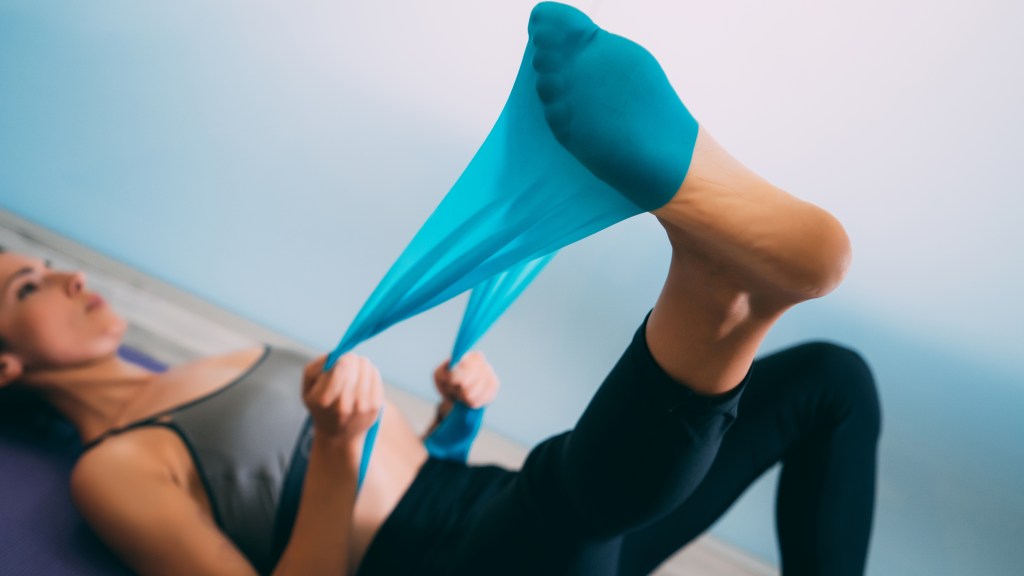
A resistance band will support the weight of the leg to help the core.
✔️ 5. Slow the tempo, let it flow
“Let the hip glide, not snap.”
✔️ 6. Strengthen the glutes
Especially glute med and deep rotators.
✔️ 7. Balance mobility with stability
Lengthen what’s tight, strengthen what’s underworking.
Final Thoughts
Snapping Hip Syndrome is rarely something to fear—but it is something to understand. With thoughtful cueing, intelligent range management, and a focus on neutral alignment and core stability, we can help clients move with more ease, less noise, and far greater confidence.
 BODY SOUL WELL